Vitamin K2 benefits inside Boostaro: the heart-health case
Updated August 2026 · reviewed by the Boostaro Research Team. We are an independent information resource, not a medical provider, and this article is educational rather than medical advice.
Vitamin K2 is the nutrient that tells your body where to put its calcium — steering it into bone, where it strengthens the skeleton, and helping keep it out of artery walls, where it does not belong. That single job, called calcium routing, is why K2 sits inside a blood-flow formula like Boostaro alongside the ingredients most people expect, and why it has become one of the more interesting nutrients in the conversation about cardiovascular wellness.
Vitamin K2 benefits, in one place.
- What it is
- A fat-soluble vitamin, distinct from K1, that activates the proteins your body uses to manage calcium.
- What it does
- Helps direct calcium toward bone and away from soft tissue such as artery walls.
- Heart angle
- Matrix Gla protein, switched on by K2, helps arteries stay flexible; observational studies link higher intake with better arterial markers.
- Best form
- MK-7 lasts longest in the blood, so it is the form most often used in daily supplements.
- Honest caveat
- The heart evidence is promising, not proof; K2 is a supportive nutrient, not a treatment.
If you have scanned the label on Boostaro, vitamin K2 may be one of the less familiar names on it — overshadowed by L-citrulline and CoQ10. But it is there for a considered reason. This guide explains, in plain language, what vitamin K2 actually does, how it manages calcium, what the research says about the heart, and where a nutrient like this fits into a healthy routine.
What is vitamin K2, and how is it different from K1?
Vitamin K2 is a fat-soluble vitamin whose defining role is to activate a small group of proteins that manage calcium, and it is chemically and functionally distinct from the more famous vitamin K1. K1, which you get from leafy greens, is used mainly by the liver for blood clotting. K2 travels further into the body — to bone and blood-vessel tissue — where it switches on the proteins that decide where calcium ends up. Our guide to nattokinase and circulation goes into this in more detail.
That division of labour matters. Plenty of K1 in a salad does not guarantee the K2 your arteries and bones rely on, because the body converts only a limited amount of K1 into K2. K2 comes largely from fermented foods and certain animal products, not staples of a modern Western diet — one reason the nutrient has drawn attention.
Where does vitamin K2 come from in the diet?
The richest natural source of vitamin K2 is natto, a Japanese fermented-soybean dish most Western palates never encounter. Beyond that, K2 appears in smaller amounts in cheeses, egg yolks, grass-fed butter, and organ meats. Because these foods are inconsistent in most diets, K2 intake tends to be low and variable — the gap a formulated supplement is designed to close. In a large prospective cohort, Geleijnse and colleagues, The Journal of Nutrition (2004) found that higher dietary menaquinone intake was associated with lower coronary heart disease risk.
How does vitamin K2 help direct calcium in the body?
Vitamin K2 manages calcium by activating two calcium-binding proteins — osteocalcin and matrix Gla protein — that cannot do their jobs until K2 switches them on. Think of these proteins as workers who arrive on site but stay idle until vitamin K2 hands them their tools. Once activated, osteocalcin helps bind calcium into the bone matrix, strengthening the skeleton, while matrix Gla protein (MGP) works in the opposite direction in blood vessels, helping prevent calcium from depositing in artery walls. Hariri and colleagues, Open Heart (2021) is a narrative review of what is and is not established about vitamin K2 and vascular calcification.
This is the heart of the vitamin K2 calcium story. Calcium is essential, but only helpful in the right place: in bone it is structural, while in an artery wall it contributes to stiffness. K2 does not add or remove calcium — it helps the body put what it has where it is useful. When K2 is scarce, more of these proteins stay inactive and calcium management is less efficient.
| Feature | Vitamin K1 (phylloquinone) | Vitamin K2 (menaquinone) |
|---|---|---|
| Main dietary source | Leafy green vegetables | Fermented foods, cheese, egg yolk |
| Primary role | Blood clotting in the liver | Calcium routing in bone & vessels |
| Reaches bone & arteries | Limited | Yes, its main site of action |
| Key proteins activated | Clotting factors | Osteocalcin & matrix Gla protein |
| Typical dietary intake | Usually adequate | Often low and variable |
What does the research say about K2 and cardiovascular wellness?
The cardiovascular case for vitamin K2 rests on one clear biological mechanism and a body of promising but not conclusive observational research. The mechanism is matrix Gla protein: it is one of the most potent known inhibitors of soft-tissue calcification, and it depends entirely on vitamin K to become active. That gives K2 a plausible, well-understood role in helping arteries stay flexible rather than stiff.
On the population side, several large observational studies report that people with higher dietary K2 intake tend to show better markers of arterial health. Data of this kind can show a relationship but cannot prove cause and effect, and controlled trials so far are smaller and more mixed. So the honest summary is this: the biology is compelling and the population signals are encouraging, but K2 has not been proven to prevent heart disease. It is best understood as one supportive nutrient for cardiovascular wellness, not a shortcut around a healthy lifestyle or medical care.
Why does vitamin K2 matter specifically for men?
Vitamin K2 is relevant to men because the same arterial flexibility it supports underpins the healthy circulation that everyday male vitality depends on. Blood flow is not only about producing enough nitric oxide to widen a vessel; it also depends on that vessel being supple enough to respond. Stiff, calcium-laden arteries respond poorly no matter how good the nitric-oxide signal is — which is why a formula focused on circulation has a logical reason to look after vessel structure as well as vessel signalling. We look at what L-lysine and L-proline do for blood vessels separately, if you want the longer version.
That is the thinking behind pairing vitamin K2 for men with ingredients like L-citrulline and pine bark. Citrulline feeds the pathway that tells vessels to relax; K2 supports the tissue that has to do the relaxing. You can read more about the signalling side in our guide to how L-citrulline supports healthy blood flow, which covers the nitric-oxide half of the same picture.
See the exact dose in Boostaro
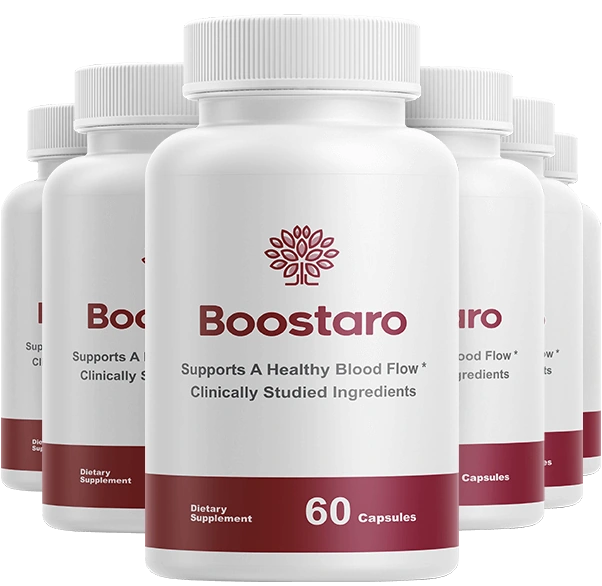
Boostaro is a twice-daily capsule that combines vitamin K2 with L-citrulline, pine bark, vitamin C and CoQ10 — signalling and structure in one blend. The six-bottle bundle is the best value at $49 per bottle, with free U.S. shipping and a 180-day guarantee.
Check today’s Boostaro pricing — from $49/bottleMK-4 or MK-7: which form of vitamin K2 is in play?
Vitamin K2 comes in more than one form, and the two that matter most are MK-4 and MK-7, which differ mainly in how long they stay active in the blood. MK-7 has a long half-life, meaning a single dose keeps blood levels of K2 elevated for a day or more, so it is the form most often chosen for once- or twice-daily supplements that aim to keep the calcium-routing proteins steadily supplied. MK-4 clears from the blood far more quickly and tends to appear in food and in higher-dose, more frequently taken formulas. In a one-year randomised trial in post-menopausal women, de Vries and colleagues, Nutrients (2025) measured the effect of menaquinone-7 supplementation on vascular stiffness and blood pressure.
For a daily wellness supplement, MK-7 is generally the more practical choice because consistency is what activates those proteins over time. The table below lays out the practical differences.
| Form | Half-life in blood | Typical use | Common source |
|---|---|---|---|
| MK-4 | Short (hours) | Higher, more frequent doses | Animal foods; some formulas |
| MK-7 | Long (days) | Once- or twice-daily supplements | Natto; most K2 supplements |
| What it means | Rises and falls quickly | Keeps proteins steadily supplied | Diet is inconsistent, hence supplements |

How much vitamin K2, and how does Boostaro fit?
Vitamin K2 is used at microgram doses, far smaller than the gram-scale amounts of an amino acid like citrulline, and consistency matters more than any single large serving. Research and supplement labels commonly work in the range of tens to roughly a couple of hundred micrograms of K2 per day, usually as MK-7. Because it is fat-soluble, K2 is best absorbed alongside a meal containing some fat.
Vitamin K2 is also frequently paired with vitamin D. The logic is neat: vitamin D increases how much calcium your body absorbs from food, and vitamin K2 helps direct where that newly absorbed calcium goes. Absorption without routing is only half the system. This is why K2 rarely works alone in a well-designed formula — the same team-of-nutrients philosophy that shapes the rest of Boostaro’s formula, where each ingredient supports one part of the circulatory picture.
Who should be cautious with vitamin K2?
The single most important caution with vitamin K2 applies to anyone taking a blood-thinning medication, because vitamin K directly affects how blood clots. Warfarin, in particular, works by blocking vitamin K, so adding a K vitamin can interfere with the medication and its dosing. If you take warfarin or any anticoagulant, do not start vitamin K2 without talking to the doctor who manages that prescription. There is a fuller companion piece on vitamin C and healthy blood vessels.
For most other adults, vitamin K2 is generally well tolerated at the amounts used in supplements. Still, if you have a medical condition, take any regular medication, or are unsure, the right move is the same: speak with a qualified healthcare professional first. Vitamin K2 supports a healthy lifestyle; it is not a treatment for any medical condition.
Frequently asked questions
What are the main vitamin K2 benefits?
Vitamin K2 activates proteins that help direct calcium in the body, guiding it toward bone where it belongs and helping keep it out of soft tissue such as artery walls. That calcium-routing role is why K2 is studied for both bone strength and cardiovascular wellness.
How does vitamin K2 affect calcium?
Vitamin K2 switches on two proteins, osteocalcin and matrix Gla protein. Osteocalcin helps bind calcium into bone, while matrix Gla protein helps prevent calcium from settling in arteries. Without enough K2, those proteins stay inactive and calcium is less well managed.
Is vitamin K2 good for the heart?
Observational research links higher vitamin K2 intake with better markers of arterial health, and matrix Gla protein has a clear biological role in keeping arteries flexible. The evidence is promising but not proof that K2 prevents heart disease, so it is best seen as one supportive nutrient among many.
What is the difference between MK-4 and MK-7?
MK-4 and MK-7 are both forms of vitamin K2. MK-7 stays in the bloodstream much longer after a dose, so it is the form most often chosen for once-daily supplements aiming to keep activity steady. MK-4 clears more quickly and appears in some foods and higher-dose formulas.
Should men take vitamin K2 with vitamin D?
Vitamin D raises how much calcium the body absorbs, and vitamin K2 helps direct where that calcium goes. Many formulas pair the two so absorption and routing work together, though you should follow product directions and speak with your doctor about your own needs.
Is vitamin K2 safe for men to take?
Vitamin K2 is generally well tolerated. The important exception is anyone taking a blood-thinning medication such as warfarin, because vitamin K affects clotting. If you take any medication or have a medical condition, speak with your doctor before starting K2.
See the exact dose in Boostaro — risk-free for 180 days →
Boostaro is a dietary supplement, not a treatment for any medical condition. These statements have not been evaluated by the Food and Drug Administration. This product is not intended to diagnose, treat, cure or prevent any disease. Always consult a qualified healthcare professional about your individual needs.
References & further reading
- National Institutes of Health, Office of Dietary Supplements. Vitamin K — Fact Sheet for Health Professionals. ods.od.nih.gov/factsheets/VitaminK-HealthProfessional
- Examine.com. Vitamin K2 — evidence-based summary. examine.com/supplements/vitamin-k2
- Geleijnse JM, et al. Dietary intake of menaquinone is associated with a reduced risk of coronary heart disease: the Rotterdam Study. J Nutr. 2004. pubmed.ncbi.nlm.nih.gov/15514282
- Hariri E, et al. Vitamin K2 – a neglected player in cardiovascular health: a narrative review. Open Heart. 2021. pubmed.ncbi.nlm.nih.gov/34785587
- de Vries F, et al. Effects of One-Year Menaquinone-7 Supplementation on Vascular Stiffness and Blood Pressure in Post-Menopausal Women. Nutrients. 2025. pubmed.ncbi.nlm.nih.gov/40077685
- Harvard T.H. Chan School of Public Health, The Nutrition Source. Vitamin K. nutritionsource.hsph.harvard.edu/vitamin-k
These references describe the ingredients in general terms and do not constitute evidence that any product treats, cures or prevents any condition.
Keep reading: the best foods for blood flow and circulation · nitric oxide and male vitality · back to the Boostaro blog · homepage.