L-lysine and L-proline for blood vessels: the Boostaro guide

Updated August 2026 · reviewed by the Boostaro Research Team. We are an independent information resource, not a medical provider, and this article is educational rather than medical advice.
L-lysine and L-proline are two amino acids Boostaro includes for a specific structural reason: they are the raw material your body uses to build collagen, the protein that gives blood-vessel walls much of their strength and springy flexibility. Where L-citrulline helps vessels relax and widen, these two help supply the scaffolding those vessels are built from — a quieter, more foundational job that works alongside a healthy diet and lifestyle rather than in place of one.
L-lysine and L-proline for vessels, in one place.
- What they are
- Two amino acids the body uses as building blocks for collagen, the main structural protein in vessel walls.
- What they do
- Supply raw material for collagen synthesis, which supports the strength and flexibility of the vessel wall.
- The vitamin C link
- Vitamin C is a required cofactor; without it, lysine and proline cannot form stable, mature collagen.
- Honest evidence
- The collagen biology is well established; direct proof that supplements improve vessel health is limited.
- Food sources
- Both are found in everyday protein foods; supplements offer a more consistent amount.
If you scan the label on Boostaro, L-citrulline and pine bark usually get the attention because they act on the nitric-oxide pathway. But two amino acids further down — L-lysine and L-proline — play a different and complementary part. This guide explains what collagen is doing inside a blood vessel, why these two amino acids matter to it, what the evidence honestly shows, and where diet fits alongside a capsule.

What are L-lysine and L-proline?
L-lysine and L-proline are amino acids, the small molecules that link together to form proteins. L-lysine is an essential amino acid, meaning the body cannot make it and must get it from food or supplements. L-proline is non-essential, so the body can produce some on its own, but demand rises whenever tissue is being built or repaired. Both turn up again and again in one particular protein: collagen.
Collagen is the most abundant protein in the human body, and proline is one of its signature ingredients — large stretches of the collagen molecule are built from repeating units rich in proline and its modified form, hydroxyproline. Lysine, likewise, is chemically altered into hydroxylysine, which the body then uses to lock collagen fibres together. In short, these are not random amino acids; they are two of the specific bricks collagen is made from.
How do collagen amino acids support blood-vessel walls?
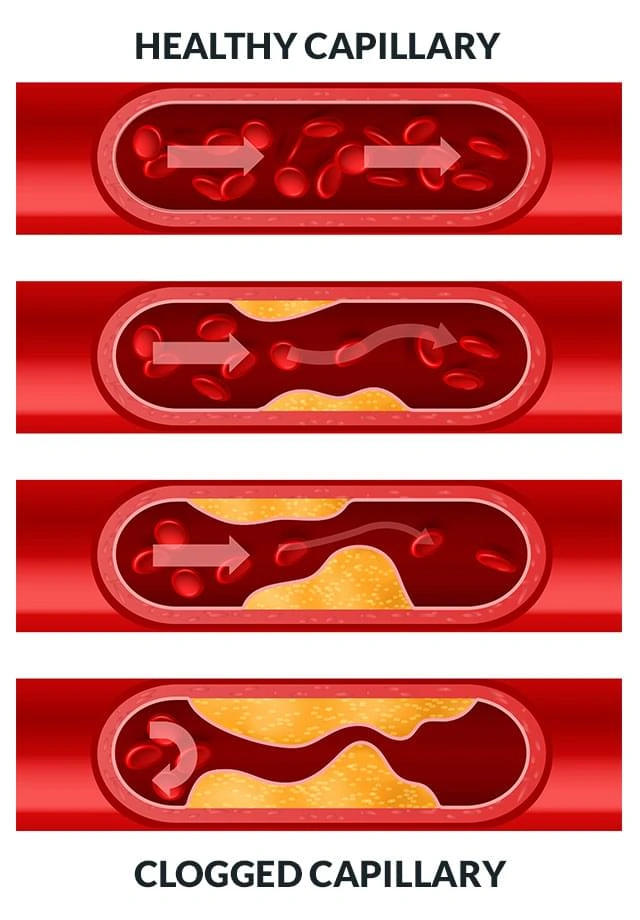
Collagen is what gives a blood-vessel wall its tensile strength and its ability to stretch and recoil with each heartbeat. Arteries, veins and the tiny capillaries all rely on a collagen-rich framework to hold their shape under pressure without tearing or ballooning, and the amino acids that build that framework are therefore part of the story of vascular resilience.
What is collagen doing inside a blood vessel?
A blood vessel is not a passive pipe. Its wall is a layered structure in which a thin lining of cells sits on a bed of connective tissue, and collagen is the dominant structural protein in that connective tissue. It provides the tensile backbone that resists the pressure of blood being pushed through with every beat, while elastin adds the springiness that lets the vessel recoil. When that collagen framework is healthy and well organised, the wall stays strong yet flexible — exactly the combination healthy circulation depends on. For the vascular picture more broadly, Ashor and colleagues, Atherosclerosis (2014) pooled randomised trials of vitamin C and endothelial function.
Why do lysine and proline matter for collagen?
Because you cannot build collagen without them. Proline and lysine are incorporated directly into the collagen chain, then chemically modified — a process called hydroxylation — to create the hydroxyproline and hydroxylysine that give collagen its stability and let its fibres cross-link into strong bundles. If the raw material or the machinery is short, the collagen the body produces is weaker and less stable. That is the mechanistic reason these two amino acids appear in a formula aimed at circulation.
Do lysine and proline need vitamin C to work?
Yes — and this is one of the most important and least-appreciated points about collagen. The enzymes that hydroxylate proline and lysine, turning them into the stable forms collagen needs, require vitamin C as a cofactor to function. Without enough vitamin C, those enzymes stall, and the body cannot form mature, stable collagen. This is the biochemistry behind scurvy, the classic vitamin-C-deficiency disease in which weakened connective tissue leads to fragile blood vessels and bleeding gums. Vitamin C is the cofactor those hydroxylation steps depend on; Carr and Maggini, Nutrients (2017) summarises its wider physiological roles.
The practical takeaway is that lysine and proline do not work in isolation. They are one half of a partnership with vitamin C, which is exactly why Boostaro’s formula includes vitamin C alongside them. Supplying the amino-acid building blocks and the cofactor together is more logical than supplying either alone.
| Amino acid | Type | Role in collagen | Vessel relevance |
|---|---|---|---|
| L-proline | Non-essential | Backbone of the collagen chain; converted to hydroxyproline for stability | Supports the structural framework of the wall |
| L-lysine | Essential | Converted to hydroxylysine; enables cross-linking between fibres | Supports fibre strength and integrity |
| Vitamin C | Cofactor | Required by the enzymes that modify proline and lysine | Enables stable, mature collagen to form |
See the exact dose in Boostaro →
What does the evidence actually show?
Here honesty matters more than enthusiasm. The role of lysine and proline in collagen synthesis is textbook cell biology and is not in dispute — you genuinely cannot build collagen without them, and vitamin C is genuinely required to stabilise it. What is far less certain is whether taking extra lysine and proline as supplements measurably improves blood-vessel health in people who already eat adequate protein. Our guide to vitamin C and healthy blood vessels goes into this in more detail.
Most adults on a normal diet get plenty of both amino acids from food, so “more raw material” is not automatically better if you are not short of it in the first place. Direct human trials testing lysine and proline supplements specifically for vascular outcomes are limited, and much of the excitement traces back to laboratory and theoretical work rather than large clinical studies. We think the fair summary is this: the biology is solid, the supplement evidence is thin, and these amino acids are best understood as nutritional support for a normal process — not a proven therapy.
How do lysine and proline fit into Boostaro’s formula?
Boostaro is built as a small team of nutrients supporting healthy circulation from several angles rather than a single hero ingredient. L-citrulline and pine bark extract lean toward the nitric-oxide pathway that helps vessels relax and widen; L-lysine, L-proline and vitamin C lean toward the structural side, supplying material and cofactor for the collagen framework; and nutrients such as CoQ10 and magnesium support the energy and muscle tone behind vascular function. The logic is that a vessel needs both to be flexible enough to widen and strong enough to hold, and no single amino acid covers both. Shoulders and Raines, Annual Review of Biochemistry (2009) is the standard reference on collagen structure and on the role proline and its hydroxylated form play in stabilising the triple helix.
If you want the widening side of that story, our companion guide on how L-citrulline supports healthy blood flow covers the nitric-oxide pathway in detail, and our overview of nitric oxide and male vitality ties the whole picture together.
Support the structure, not just the flow
Boostaro is a twice-daily capsule that pairs L-lysine, L-proline and vitamin C with L-citrulline, pine bark and CoQ10. The six-bottle bundle is the best value at $49 per bottle, with free U.S. shipping and a 180-day guarantee.
Order Boostaro — from $49/bottleHow much do people take, and can food do the job?
Both amino acids are widely available in ordinary protein foods, so most people already have a steady dietary supply. Lysine is concentrated in meat, fish, eggs, dairy and legumes; proline shows up in the same protein-rich foods and, notably, in gelatin and bone broth, which are especially high in it. For someone eating enough protein, food covers the baseline.
Supplement amounts vary a great deal from product to product, and there is no single official target for vascular support, which is one more reason to treat any specific number with caution. The sensible rule is to follow the directions on the label you choose — Boostaro is taken as two capsules a day — and to remember that consistency and an overall healthy diet do more than any one serving.
| Source | Rich in | Notes |
|---|---|---|
| Meat, poultry, fish | Lysine & proline | Complete protein; reliable everyday source |
| Eggs & dairy | Lysine & proline | Good sources for most diets |
| Legumes & soy | Lysine | Key plant source of the essential amino acid |
| Gelatin & bone broth | Proline | Traditionally high in proline and glycine |
| Supplement | Both, plus vitamin C | Consistent amount; convenient alongside diet |
Who should talk to a doctor first?
For most healthy adults, L-lysine and L-proline are generally well tolerated at the modest amounts found in supplements, and both are eaten daily in ordinary food. That said, if you are pregnant or breastfeeding, have kidney or liver conditions, or take prescription medication, it is wise to speak with your doctor before adding any concentrated amino-acid supplement. These nutrients are intended for adults, and they are a support to a healthy lifestyle — not a treatment for any medical condition.
Frequently asked questions
What do L-lysine and L-proline do for blood vessels?
L-lysine and L-proline are two amino acids the body uses as raw material to build collagen, the structural protein that gives blood-vessel walls much of their strength and elasticity. By supplying that raw material, they support the body’s own collagen-building machinery rather than acting on vessels directly like a drug.
Are L-lysine and L-proline the same as collagen?
No. They are individual amino acids, and collagen is a large protein assembled from many amino acids, with proline especially abundant in it. Think of lysine and proline as two of the bricks, and collagen as the finished wall the body builds from them.
Do lysine and proline need vitamin C to work?
Vitamin C is a required cofactor for the enzymes that modify proline and lysine during collagen synthesis. Without enough vitamin C the body cannot form stable, mature collagen, which is why blood-flow formulas often pair these amino acids with vitamin C.
How much L-lysine and L-proline do people take?
Both are found in ordinary protein foods, and lysine is an essential amino acid most people get from diet. Supplement amounts vary widely by product, so the sensible approach is to follow the directions on the label you choose and speak with your doctor if you take medication.
Is the evidence for vessel benefits strong?
The role of lysine and proline in collagen biology is well established, but direct human evidence that supplementing them improves blood-vessel health specifically is limited. They are best viewed as nutritional support for a normal process, not a proven treatment. We look at vitamin K2 and heart health separately, if you want the longer version.
Is it safe to take L-lysine and L-proline?
For most healthy adults these amino acids are generally well tolerated at typical supplement amounts. If you are pregnant, have kidney or liver conditions, or take medication, speak with your doctor first. They are intended for adults.
Check today’s Boostaro pricing →
Boostaro is a dietary supplement, not a treatment for any medical condition. These statements have not been evaluated by the Food and Drug Administration. This product is not intended to diagnose, treat, cure or prevent any disease. Always consult a qualified healthcare professional about your individual needs.
References & further reading
- Examine.com. Lysine — evidence-based summary. examine.com/supplements/lysine
- Harvard T.H. Chan School of Public Health, The Nutrition Source. Collagen. nutritionsource.hsph.harvard.edu/collagen
- National Institutes of Health, Office of Dietary Supplements. Vitamin C — Fact Sheet for Health Professionals. ods.od.nih.gov/factsheets/VitaminC-HealthProfessional
- MedlinePlus, U.S. National Library of Medicine. Lysine. medlineplus.gov/druginfo/natural/237.html
- Shoulders MD, Raines RT. Collagen structure and stability. Annu Rev Biochem. 2009. pubmed.ncbi.nlm.nih.gov/19344236
- Carr AC, Maggini S. Vitamin C and Immune Function. Nutrients. 2017. pubmed.ncbi.nlm.nih.gov/29099763
These references describe the ingredients in general terms and do not constitute evidence that any product treats, cures or prevents any condition.
Keep reading: how L-citrulline supports healthy blood flow · the best foods for blood flow and circulation · back to the Boostaro blog · homepage.